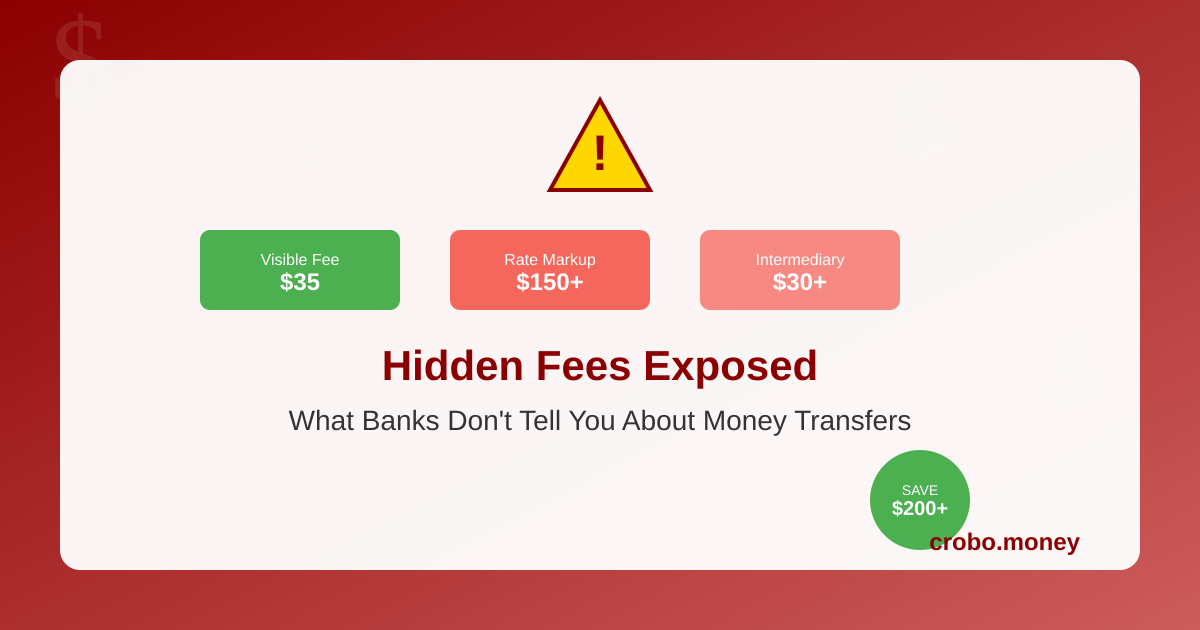
Your bank makes it sound simple: “Wire transfer fee: $35.” What they don’t mention is that this fee is just the beginning. The real cost of bank transfers includes layers of hidden charges that can eat up 5-8% of your hard-earned money. Let’s expose these hidden fees and show you how to keep more money in your family’s hands.
Fee #1: The Exchange Rate Markup (The Biggest Hidden Cost)
When Bank of America or Chase converts your dollars to rupees, they don’t use the rate you see on Google. They add a “spread” or markup, typically 2-4% below the mid-market rate. On a $10,000 transfer, that’s $200-400 lost before any other fees apply. Banks justify this as a “foreign exchange fee” buried in the fine print.
Fee #2: Correspondent Bank Fees
International wire transfers often pass through intermediary banks (correspondent banks) before reaching India. Each one can deduct $15-30 from your transfer. You send $5,000, but only $4,940 arrives. These fees are deducted automatically without your consent.
Fee #3: Receiving Bank Charges in India
Indian banks charge to receive international wires, typically ₹500-1,500 ($6-18). Some banks like HDFC waive this for NRI accounts, while others charge regardless. Ask your recipient to check their bank’s policy.
Fee #4: SWIFT Network Charges
SWIFT (Society for Worldwide Interbank Financial Telecommunication) facilitates international transfers but charges banks for using its network. These costs get passed on to you, usually bundled into the “wire transfer fee.”
The True Cost: A Real Example
| Cost Component | Bank Wire | Crobo Transfer |
|---|---|---|
| Amount Sent | $5,000 | $5,000 |
| Transfer Fee | $45 | $0 |
| Exchange Rate Loss (3%) | $150 | $15 |
| Correspondent Fee | $30 | $0 |
| Receiving Fee | $12 | $0 |
| Total Fees | $237 | $15 |
| Amount Received (INR) | ₹4,01,325 | ₹4,20,650 |
Why Banks Get Away With This
Banks rely on customer inertia and trust. You’ve banked with Chase for years, so transferring money through them feels “safe.” They also make it inconvenient to compare by not showing the exchange rate until after you initiate the transfer. This information asymmetry keeps billions flowing through expensive channels.
How Fintech Companies Changed the Game
Companies like Crobo, Wise, and others disrupted this model by using peer-to-peer matching and local bank partnerships instead of SWIFT. This eliminates correspondent banks and enables near mid-market rates. The savings are passed directly to you.
Five Ways to Avoid Hidden Fees
First, always check the exchange rate against Google before transferring. Second, avoid bank wires for amounts under $10,000 since fintech apps are almost always cheaper. Third, use ACH or bank transfer funding instead of debit or credit cards to reduce costs. Fourth, time your transfers when rates are favorable using rate alert features. Fifth, stick with specialists for the US-India corridor like Crobo.
Leave a Reply