Finding the best apps to send money to India from USA can feel overwhelming when so many options promise low fees and fast transfers. For Indian expats living in the United States, sending money back home is not just a financial transaction — it is a way to support family, pay for emergencies, fund education, and stay connected to roots. Whether you are sending a few hundred dollars every month or a larger amount for a special occasion, choosing the right app can save you real money and spare you from unnecessary stress. This guide breaks down everything you need to know in plain, simple English so you can make a confident choice.
Why Does Choosing the Right Money Transfer App Matter So Much?
Most people assume that sending money abroad is straightforward — pick any app, enter the amount, and hit send. But the reality is that the difference between a good app and a bad one can cost you tens or even hundreds of dollars per transfer. Every app makes money somewhere, and it is often hidden inside the exchange rate rather than shown as a flat fee. When you send USD to INR, even a small difference in the exchange rate can mean your family receives significantly less money on the other side.
For NRIs who send money regularly, these small differences add up fast over a year. A transfer app that charges you a slightly worse exchange rate every single month could cost you the equivalent of an entire extra transfer by year’s end. That is money that could have gone to your parents, your children’s school fees, or your savings back home. This is exactly why it is worth spending a few minutes comparing your options before you commit to one platform.
What Are the Most Popular Apps to Send Money to India from USA?
There are several well-known platforms that NRIs use regularly. Each one has its own strengths, fee structures, and delivery speeds. Here is a quick overview of the most commonly used services:
| App / Service | Transfer Fee | Exchange Rate Margin | Delivery Speed | Best For |
|---|---|---|---|---|
| Wise (formerly TransferWise) | Low flat fee | Mid-market rate | 1–2 business days | Transparency seekers |
| Remitly | Varies by speed | Small margin added | Minutes to 3–5 days | Fast transfers |
| Western Union | Higher fees | Wider margin | Same day to 5 days | Cash pickup options |
| PayPal / Xoom | Moderate fees | Noticeable margin | Minutes to 2 days | PayPal users |
| crobo.money | Minimal to zero | Competitive USD-to-INR | Fast bank transfer | NRIs sending regularly |
This table gives you a starting point, but the right choice depends on your personal situation — how often you send money, how much you typically transfer, and how quickly the recipient needs the funds.
How Do Exchange Rates and Hidden Fees Actually Work?
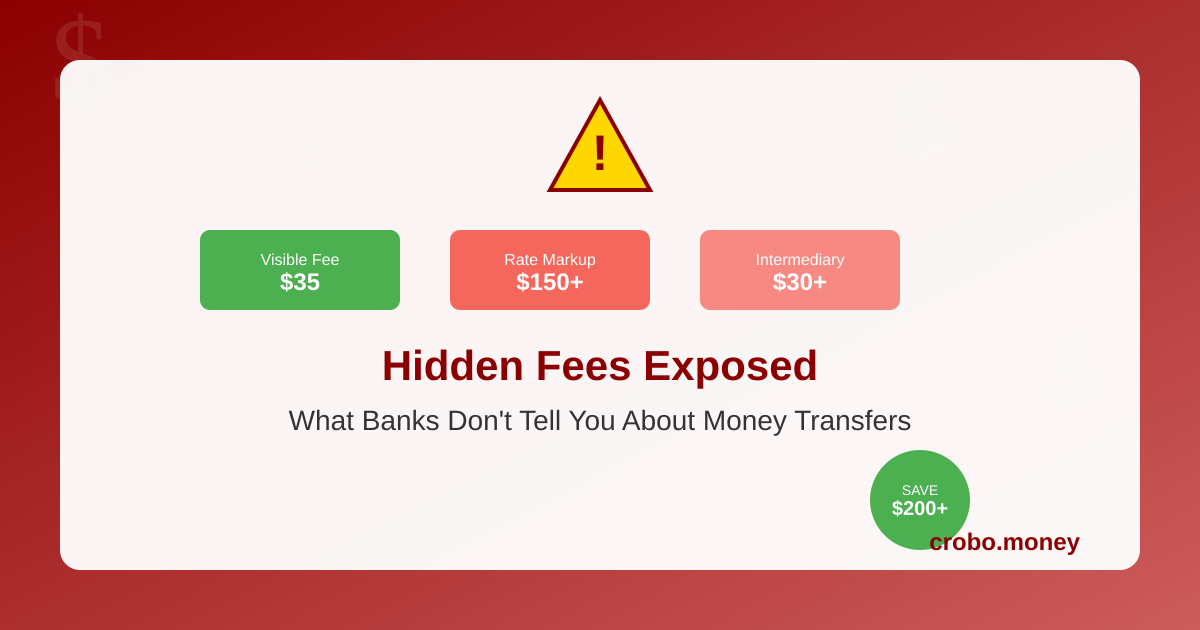
Here is something many transfer apps do not advertise clearly: the exchange rate you see in the app is almost never the real mid-market rate. The mid-market rate is the rate you see on Google when you search “USD to INR today.” Most apps take that number and add a small percentage on top. This is called the exchange rate margin, and it is one of the most common ways transfer services make their money.
For example, if the mid-market rate is 84 INR per USD but the app offers you 82.50 INR per USD, you are losing 1.50 rupees on every single dollar you send. If you send $1,000, your family receives 1,500 rupees less than they would at the real rate. That might not sound huge on one transfer, but over 12 months it adds up to a meaningful amount.
Always look at the total amount your recipient will receive in INR, not just the fee shown on the app. That final number tells the real story.
Which App Is Fastest for Urgent Transfers to India?
When a family emergency strikes, speed becomes more important than saving a few rupees. Several apps offer near-instant or same-day transfers to Indian bank accounts, though they sometimes charge a premium for the faster service.
Remitly is well known for its express transfer option that can deliver funds to an Indian bank account within minutes, though you will pay a higher fee for that speed. Xoom (owned by PayPal) also offers fast transfers when funded by a debit card. Wise, on the other hand, is usually slower — often one to two business days — but offers better rates in return.
If you need to send money urgently and want both speed and a fair rate, it is worth checking newer platforms that have been built specifically for the NRI community, since they often strike a better balance between transfer speed and exchange rate quality.
Are These Apps Safe and Regulated?
Safety is a completely valid concern when you are moving significant amounts of money across international borders. The good news is that all of the major apps discussed here are regulated by US financial authorities. Most are registered as Money Services Businesses (MSBs) with FinCEN, and many are also licensed in individual US states.
When choosing any of the best apps to send money to India from USA, look for these safety signals: a clear physical address and customer support contact, strong encryption for your financial data, compliance with Know Your Customer (KYC) requirements, and a solid track record of user reviews. Avoid any platform that promises unusually high exchange rates with no clear explanation — if it sounds too good to be true, it probably is.
What Should NRIs Look for When Comparing Transfer Apps?
As an NRI sending money home regularly, your priorities will likely be different from someone making a one-time transfer. Here is a practical checklist to guide your comparison:
- Total amount received in INR: Always calculate the end amount, not just the upfront fee.
- Transfer limits: Some apps cap how much you can send per day or per month. Make sure the limits work for your needs.
- Bank compatibility: Confirm the app can transfer directly to the specific Indian bank your family uses — SBI, HDFC, ICICI, Axis, and others.
- Customer support quality: Delays happen. When they do, you want to be able to reach a real person quickly.
- Recurring transfer options: If you send a fixed amount every month, look for apps that support scheduled or automatic transfers so you do not have to log in manually each time.
- Mobile app experience: A clean, easy-to-use app makes a real difference when you are in a hurry.
Taking 10 minutes to compare these factors before your first transfer can save you money and frustration for years to come. Many NRIs stick with the first app they ever used simply out of habit, even when better options have since become available.
How Much Can You Actually Save by Switching Apps?
Let’s put some real numbers to this. Imagine you send $500 to India every month. Over a year, that is $6,000 in total transfers. If your current app charges a 2% exchange rate margin, you are effectively losing $120 per year to hidden fees. Switch to an app with a 0.5% margin and you save $90 annually. Switch to one with zero margin and you save the full $120 — without sending a single extra dollar.
Now scale that up. If you send $1,500 a month, the savings from switching to a better app can exceed $300 per year. Over five years, that is more than $1,500 in money that goes to your family instead of disappearing into exchange rate margins. This is why comparing the best apps to send money to India from USA is not just a smart exercise — it is genuinely worth your time.
Conclusion: Choose an App Built for NRIs, Not Just Any Transfer Tool
Sending money from the USA to India is one of the most common financial needs in the NRI community, and you deserve a service that treats that need seriously. The best apps to send money to India from USA are the ones that are transparent about every cost, offer competitive exchange rates, and make the process as simple as possible. Generic international transfer platforms often fall short because they were not designed with the USD-to-INR corridor specifically in mind.
If you are looking for a platform built specifically for NRIs that offers competitive USD-to-INR rates with zero hidden fees, take a look at crobo.money. Designed with the NRI community at its core, crobo.money keeps your transfer costs low, your exchange rates fair, and your family’s money where it belongs — in their hands, not lost in unnecessary charges. Try it today and see exactly how much more INR your dollars can deliver.